
ConstructAI: Students Develop AI Solutions for Circular Construction
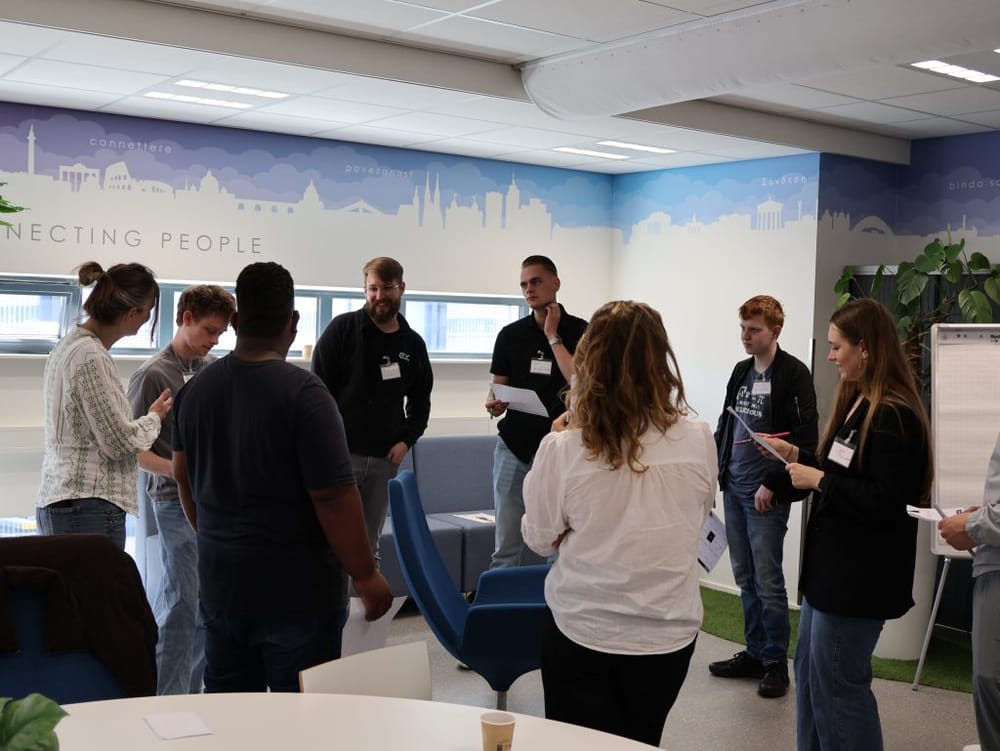
How can artificial intelligence help construction companies quickly identify which circular choices can be made? That question was at the heart of a hackathon held last week at the International Hub of TechCampus Lab (TCL) in The Hague.
The strength of the hackathon, organised by Annemiek Haneveld of MKB Digiwerkplaats, lay in the multidisciplinary composition of the teams. Students with expertise in software development, finance, and construction engineering approached the same challenge from different angles. It was precisely that combination of technical, analytical, and sector-specific knowledge that led to surprising solutions.
HAAI bridges education and practice
The hackathon is a prime example of how HAAI (The Hague Applied AI Campus) connects education, businesses, and government. Within this regional partnership, ROC Mondriaan, The Hague University of Applied Sciences, Leiden University, and TU Delft work together on a future-proof region in which AI is deployed responsibly and practically.
By allowing students to work on real business challenges during their training, they are better prepared for a labour market where AI is becoming increasingly important. At the same time, organisations gain the opportunity to discover new technologies and fresh ideas from the professionals of tomorrow.
A practical construction challenge
The challenge was brought in by Hidde Luzac, innovation manager at Dijkxhoorn Construction Group. The company sees significant opportunities for circular construction but also notes that analysing specifications and finding sustainable alternatives is very time-consuming.
Circular construction is not just about recycling, but about high-quality reuse of materials. Think of building materials originating from renovation or demolition projects that can be reused without any loss of quality.
The assignment for the students was to develop an AI-driven tool that can scan building specifications for materials and components. The software then had to match this information with a database of suppliers and available circular alternatives. Based on this, the tool would provide an indication of the extent to which a project can be executed circularly.
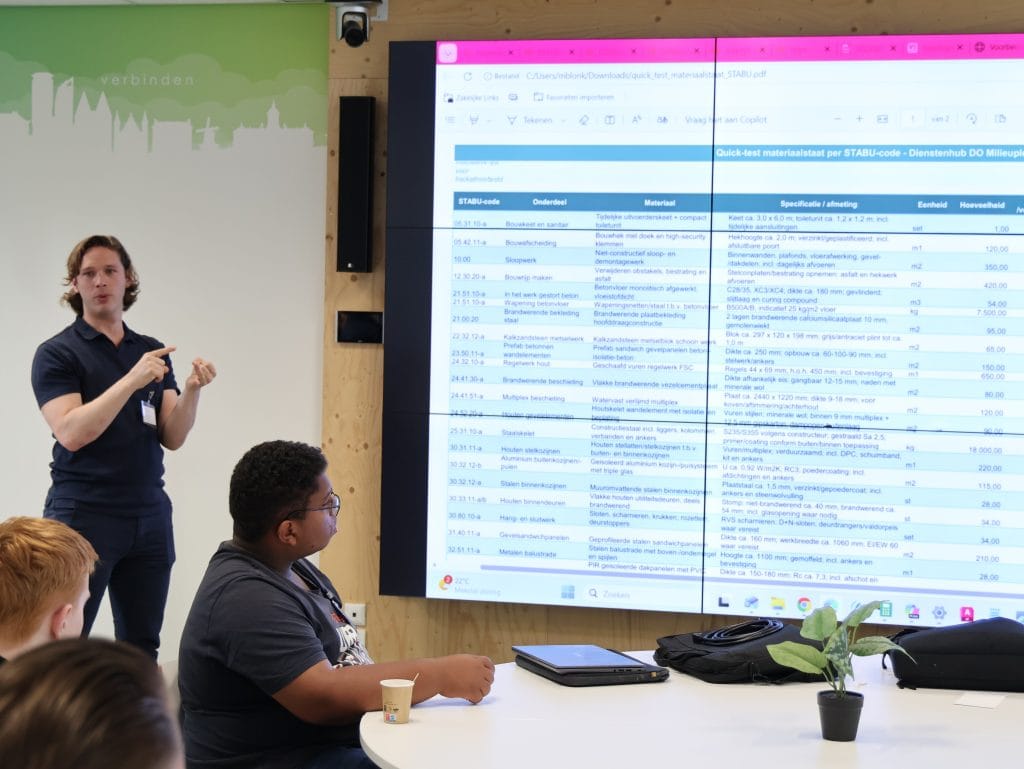
The teams also had to account for construction-specific standards such as STABU codes, as well as the end users in practice. The solution not only needed to work technically, but also had to be usable by colleagues who have little experience with AI and want quick insight into circular opportunities within a project.
AI and software development workshop
Before the teams got started, we delivered a workshop on AI tools and modern development methods. Various tools were covered, including AI-assisted programming environments and generative AI models. In addition to the technical possibilities, important topics such as usability, error handling, security, and the reliability of AI-generated software were also addressed.
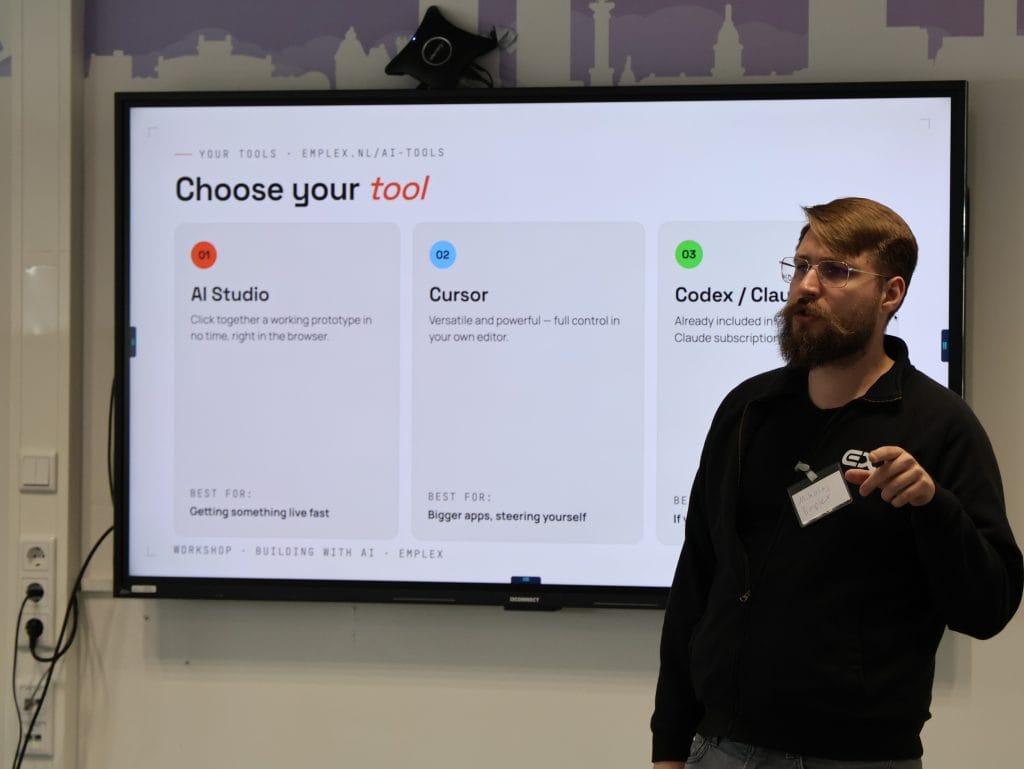
The guidance from us aligned perfectly with the goal of the hackathon: letting students experience how AI can be applied in practice to solve real problems. A special detail is that the owner of Emplex is himself an alumnus of the Software Developer programme at ROC Mondriaan and later also studied at The Hague University of Applied Sciences.
Two different approaches
After the workshop, the teams got started but approached the challenge in very different ways. Whereas one team focused strongly on vibe coding and building a working product, the other team opted for a more traditional frontend/backend development approach.
Throughout the day, the students received feedback from the client. It was not only the technical feasibility of the solutions that was looked at, but also practical questions from everyday construction practice. How would a project leader use such a system? What information is really relevant? And how do you ensure results are clear and reliable? This combination of technical innovation and domain expertise made the challenge demanding.
From idea to prototype in one day
At the end of the afternoon, both teams presented their results to the jury. The first team presented a working platform that allows users to upload building specifications, have materials recognised, and get an indication of circular opportunities within a project. Additionally, a business case was examined looking at the time savings and return for contractors.
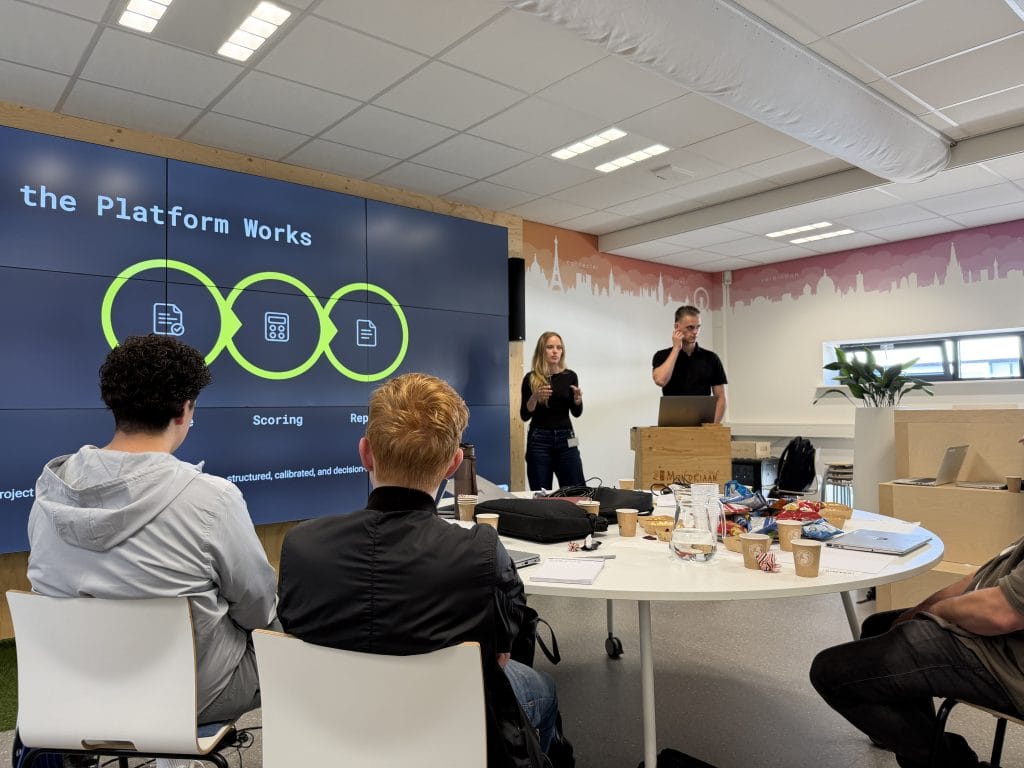
The second team presented a concept in which building specifications are automatically linked to available circular materials from various data sources. Via a user-friendly interface, users can upload documents, view matches, and generate a report that can be shared directly with clients.
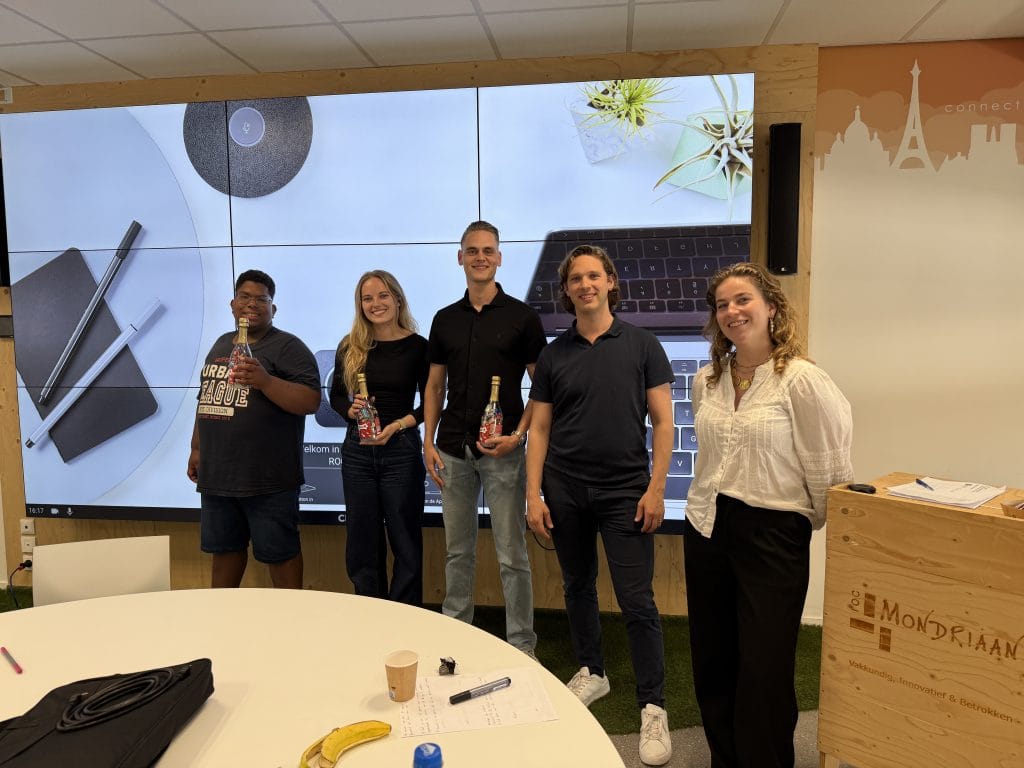
The jury evaluated the solutions on three criteria: alignment with the client's needs, creativity, and usability. One of the teams was eventually declared the winner. According to the jury, the winning team distinguished itself mainly by developing a genuinely working product that already compellingly addressed the core of the challenge.
Valuable experience for students
At least as important as the final result was the learning experience throughout the day. Students worked together with participants from different disciplines and received direct feedback from professionals in the field. As a result, technical, construction, and business insights came together in solutions for a concrete practical challenge.
For students at ROC Mondriaan, the hackathon offered a unique opportunity to work with students from other institutions and disciplines. Remarkably, the collaboration seemed completely natural. The participants quickly formed one team in which knowledge was shared, ideas were sharpened, and together they searched for the best solution for the client.
The hackathon demonstrates how valuable multilevel collaboration can be. The participants went home not only with new knowledge about AI and circular construction, but above all with the experience that the best solutions often arise when different disciplines and organisations combine their strengths.
Do you want your own usecase solved in a hackathon or have a question about this event?